
NCLEX Question Types Explained: Each Format and How Partial Credit Works
The NCLEX question types as NCSBN describes them: multiple choice, select all that apply, matrix, drop-down, highlight, bow-tie and calculation items, exhibits, case studies and partial credit.
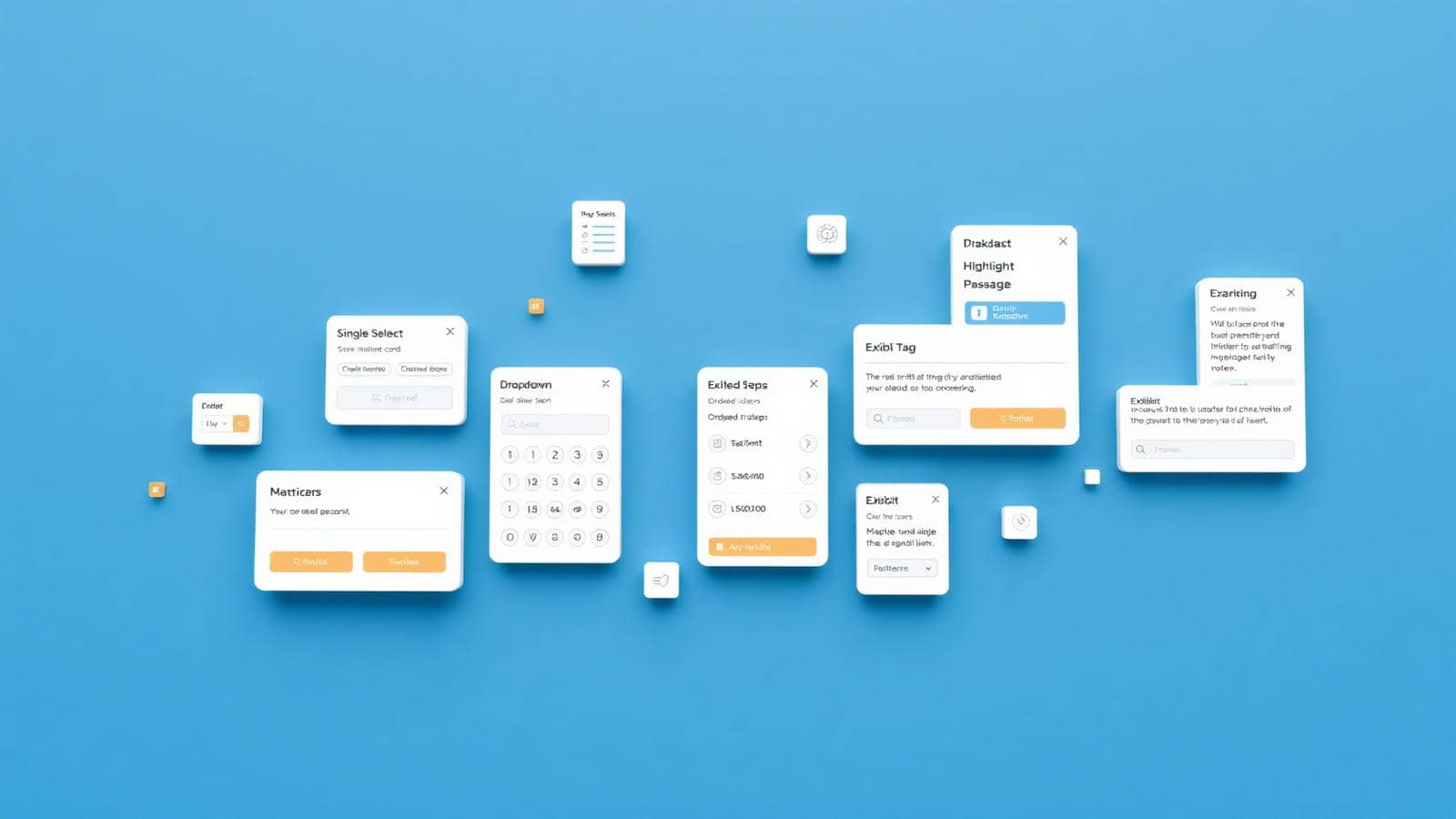
NCLEX question types go well beyond multiple choice. NCSBN's Candidate Tutorial covers multiple choice, select all that apply, select N, grouping, matrix, drop-down, highlight, bow-tie and fill-in-the-blank calculation items, and items can come with exhibit tabs. Some stand alone; others form six-item case studies. Items with more than one correct answer can earn partial credit.
NCSBN, the organization that develops the NCLEX, encourages students to become familiar with the exam's anticipated item types. This article explains each format the way NCSBN describes it, how partial credit works and what is the same on the NCLEX-RN and NCLEX-PN.
Formats and rules can change, and NCSBN updates the test plans every three years. Before you rely on any detail below, check the current pages on nclex.com.
In this article
Is the NCLEX All Multiple Choice?
No. The 2026 NCLEX Candidate Bulletin says NCLEX items have multiple formats, and both 2026 test plans say candidates may be administered stand-alone items and case studies as well as items written in multiple formats. Any item type may include charts, tables and graphics.
So is the NCLEX exam multiple choice? In part: multiple choice is one of the formats, but it has no fixed share of your exam. NCSBN's FAQ states that there is no predetermined percentage of item formats administered to candidates. The exam is computer adaptive, and items are administered based on your ability and item difficulty, regardless of format. Our guide to how the NCLEX's adaptive test works explains how it chooses each item.
New item types arrived in 2023. NCSBN's 2019 NCLEX-RN Test Plan said many items were multiple choice, other formats existed, and items were scored as either correct or incorrect, with no partial credit. The Next Generation NCLEX (NGN) launched on April 1, 2023, to better measure clinical judgment and decision making "through the use of innovative item types," and the test plans since then describe partial credit scoring for items with more than one correct answer.
Types of NCLEX Questions at a Glance
NCSBN's Candidate Tutorial (on screen, the NCLEX Item Types Tutorial) has eleven practice items, which NCSBN calls a representative sample of the items you may see. The table shows what each format asks you to do and the rule to remember, plus exhibit tabs, which items can come with.
| Format | What you do | The rule to remember |
|---|---|---|
| Multiple choice | Select one option (circles, also called radio buttons) | Options can be graphics instead of text |
| Select all that apply | Check every option that applies | At least one option is correct, and it can be just one |
| Select N | Check the number of options the question names | You cannot select more than that number |
| Multiple response grouping | Check options in each category row | Every row needs at least one check |
| Matrix multiple choice | Choose one option in each row of a table | Every row needs an answer |
| Matrix multiple response | Check boxes across rows and columns | Every column needs at least one check |
| Drop-down cloze | Complete a sentence from drop-down lists | One, two or three drop-downs per item |
| Drop-down table | Choose an option in each drop-down in a table | Every drop-down needs an answer |
| Highlight | Click the parts of a passage that answer the question | Only text that shows the hand symbol can be selected |
| Bow-tie | Drag options into the boxes of a bow-tie figure | Drag an option back to change it |
| Calculation (fill-in-the-blank) | Type a number | Round at the end; an on-screen calculator is available |
| Exhibit | Read client information behind tabs | Open every tab; the software will not prompt you |
How Each NCLEX Question Type Works
Read the instruction before the clinical data
- 1Identify the required action
- 2Identify how many selections or fields are required
- 3Review every provided source before submitting
Multiple Choice
A multiple-choice item presents a question and options preceded by circles (radio buttons), and you select one. Graphics or images can appear in the stem, in the options or in other parts of the item, such as the exhibit tabs; in NCSBN's practice item, the options are pictures instead of text.
Watch for bold words. NCSBN's FAQ says the NCLEX bolds key words such as best, most, essential, first, priority, immediately, highest, initial, next, refute, increased, decreased and support. The FAQ adds that medications appear, on most occasions, under their generic names only. Our NCLEX test-taking strategies guide explains how to work out what an item is asking before you compare the options.
Multiple Response: Select All That Apply, Select N and Grouping
In a multiple-response item, the options are preceded by boxes and you can check more than one. NCSBN's tutorial has three versions:
- Select all that apply. The question carries the qualifier "select all that apply" in bold. NCSBN's FAQ says that when it appears, one or more of the options will be a correct answer: at least one option is correct, and it can be just one.
- Select N. The question tells you how many options to select, and you cannot select more than that number.
- Grouping. The options sit in rows by category. You can check more than one option in each row, and every row needs at least one.
To change your mind, click a checked box again to clear it. The scoring section below explains why each check matters: under NCSBN's plus/minus rule, used when you may select an unspecified number of options, points are deducted for incorrect selections.
Matrix and Grid Items
A matrix, or grid, item lays the options out in a table of rows and columns. NCSBN's tutorial has two kinds:
- Matrix multiple choice: each row has circles, you select one option per row, and every row must have an answer.
- Matrix multiple response: the table has boxes, you can check more than one box per row and per column, and every column must have at least one check.
In the tutorial, a note under each table states its rule.
Drop-Down (Cloze) Items
In NCSBN's drop-down cloze, you complete a sentence or sentences by choosing from drop-down menus, and an item can have one, two or three sets of drop-down options. To change an answer, open the box and choose a different option. The tutorial notes that the drop-down cloze includes the functionality of drop-down rationale. We found no NCSBN page that says which scoring method each format uses.
A drop-down table puts the drop-downs inside a table. You open each box labeled "Select" and choose an option, and every drop-down in the table must have one selected.
Highlight Items
In a highlight item, portions of a passage are the response options. As your mouse moves over an option, it is highlighted in yellow; click it to select it, and click the highlighted text again to deselect it. A hand symbol means the text under your mouse is a response option, and a "no" symbol means it is not, so you cannot select it. The tutorial notes that highlight text includes the functionality of highlight table.
Bow-Tie Items
A bow-tie item is named for its figure. In NCSBN's practice item, one box sits in the center with two boxes on each side, each box carries a label, and three lists of options sit below the figure. You hold the mouse button down on an option, move it over a box until a bright blue box appears, and release. To change an answer, drag the option back to its list, or drag another option onto the box to replace it.
The tutorial notes that the bow-tie includes the functionality of drag-and-drop cloze and drag-and-drop rationale.
Calculation (Fill-in-the-Blank) Items
A calculation item asks you to work out a number and type it in. The answer box accepts only numbers, including a decimal point if appropriate, and you do not have to type the unit of measurement. NCSBN's FAQ adds two rules:
- The item tells you the format. It says whether to record a whole number or one to two decimal places, and when decimal places are requested, you must enter a decimal point for the answer to be considered correct.
- Round at the end. Answers should be rounded at the end of the calculation.
An on-screen calculator opens from the calculator button at the upper left of the screen. The Candidate Bulletin lists handheld calculators and conversion tables among the prohibited aids, and NCSBN's exam day page says an erasable note board and marker are provided. What to expect on test day covers the rest of the appointment.
Exhibits
The Candidate Bulletin defines an exhibit as a client chart or medical record type of item: additional information sits behind tabs on the screen, and you click a tab to read it. For case studies, the tutorial names tabs such as Nurses' Notes, Vital Signs and Diagnostic Results.
The software does not prompt you to open every tab, so you can answer without having seen all of them. NCSBN's FAQ says it is important to review each exhibit tab entirely and make an answer selection before moving to the next item. What the software does enforce is an answer: try to move on without one and you see the message "You cannot continue with this question unanswered."
Two more FAQ answers concern lab values: an item that contains a numeric lab value includes the corresponding normal reference range, and, on average, NCLEX items currently combine SI and imperial units. The NCLEX lab values guide covers how to read values in context.
Case Studies and Stand-Alone Items
A case study is a set of six items about the same client. The client information unfolds from one item to the next, and the six items address the six steps of clinical judgment in the 2026 test plans: recognize cues, analyze cues, prioritize hypotheses, generate solutions, take action and evaluate outcomes. The tutorial says a case study is marked in the gray border at the top left of the item with the number of screens, such as "Screen 1 of 6."
A stand-alone item is independent of other items, and the tutorial notes that many item types can be used as either a stand-alone or a case study item. Both 2026 test plans say clinical judgment is measured by 18 case study items (three item sets) and approximately 10% stand-alone items, selected depending on exam length. Our NCLEX clinical judgment guide walks through each of the six steps.
How Partial Credit Scoring Works
NCSBN states the rule in the same words in the 2026 test plans and its FAQ: there is partial credit scoring for items for which more than one key, or correct answer, exists. The FAQ describes three methods.
| Method | NCSBN uses it when | How points work |
|---|---|---|
| Plus/minus | You may select an unspecified number of options | Points for correct options, deductions for incorrect ones; the maximum is the number of correct options, the minimum is zero |
| Zero/one | You are told to choose a specific number of responses | Points for correct responses and none for incorrect ones; for a multipoint item, the total is the sum of the correct responses |
| Rationale | You evaluate closely associated information, typically a pair linked by a rationale such as the cause and effect of symptoms | Both parts of the pair must be correct to earn points |
NCSBN's fall 2023 Leader to Leader newsletter quoted Philip Dickison, introduced there as NCSBN's CEO and previously its chief operating officer overseeing the NCLEX launch. He described the NCLEX as extending computerized adaptive testing to "polytomously scored (partial credit) items," which he said allows better differentiation than placing responses only in "all correct" or "all incorrect" groupings.
Types of Questions on the NCLEX-RN and NCLEX-PN
NCSBN describes the item types the same way for both exams. The 2026 NCLEX-RN and NCLEX-PN Test Plans use the same sentence (candidates may be administered stand-alone items and case studies as well as items written in multiple formats) and send candidates to the same Candidate Tutorial for the formats. Both plans measure clinical judgment with 18 case study items, and NCSBN's Sample Pack includes three RN case studies and two PN case studies.
What differs is the content and the reading level. The two plans weight five of the eight content areas differently and name two of them differently; our NCLEX cheat sheet puts the 2026 percentages side by side. NCSBN's FAQ gives different reading-level ceilings: 1300L Lexiles for the NCLEX-RN and 1200L for the NCLEX-PN. The Candidate Bulletin adds that the two are separate examinations, scored on separate scales with their own passing standards.
Ordered Response, Hot Spots and Audio in Older NCSBN Materials
You may see ordered response (drag and drop), hot spots and audio items listed as NCLEX formats. Those names come from earlier NCSBN materials: the 2019 NCLEX-RN Test Plan listed multiple-choice, multiple response, fill-in-the-blank calculation, hot spots, exhibit, ordered response, audio and graphics. Its multimedia sentence named audio; the 2026 plans' sentence names charts, tables and graphics. NCSBN's 2019 article on writing clinical judgment items grouped hot spots with highlighting, the format the tutorial now calls Highlight Text.
The 2026 test plans do not list formats by name; they send candidates to the Candidate Tutorial. Its eleven practice items, a representative sample in NCSBN's words, include no item called ordered response, hot spot or audio, and its only drag-and-drop item is the bow-tie. We found no current NCSBN description of an ordered-response item, so this guide does not describe one. If a prep resource teaches one as a current format, compare it with NCSBN's current Candidate Tutorial.
Where to See the Formats Before Test Day
NCSBN's Prepare page offers three ways to see the formats:
- The Candidate Tutorial helps you become familiar with the Pearson exam software. As on the exam, you must answer each practice item before Next takes you on.
- The Sample Pack lets you experience the item types with three RN case studies, two PN case studies and additional examples.
- The Exam Preview shows how the item types fit into the overall exam.
NCSBN asks you to accept a license agreement before each of the two downloads. Our NCLEX study plan suggests where the tutorial fits in your preparation.
Frequently Asked Questions
How much of the NCLEX is multiple choice?
NCSBN does not set a share. Its FAQ says there is no predetermined percentage of item formats: the exam is computer adaptive, and items are administered based on your ability and item difficulty, regardless of format. No one can tell you in advance how many multiple-choice items you will get.
Are the types of questions on the NCLEX-RN and NCLEX-PN the same?
NCSBN describes them the same way. Both 2026 test plans use identical wording for item types, send candidates to the same Candidate Tutorial and measure clinical judgment with 18 case study items. The content weights and the reading level differ.
Do more select-all-that-apply questions mean you are doing well?
No. NCSBN says items are administered based on your ability and item difficulty, regardless of item format, so the format of your next item is not a signal. The number of items alone does not reveal a result either, as our guide to NCLEX results explains.
Do you get partial credit on the NCLEX?
Yes, on items with more than one correct answer. NCSBN scores them with one of three methods: plus/minus, zero/one or rationale scoring. Under plus/minus, points are deducted for incorrect selections, but the minimum score is zero.
Can you use a calculator on the NCLEX?
Yes, an on-screen one. The Candidate Bulletin says an on-screen calculator is available during the exam, and NCSBN's exam day page says an erasable note board and marker are provided. Handheld calculators are prohibited aids.
Do you have to open every exhibit tab?
The software does not make you. NCSBN's FAQ says it is important to review each exhibit tab entirely and make an answer selection before moving to the next item, so open them all. The only thing the software enforces is an answer.
Before You Test
Knowing the formats keeps the screen from surprising you on test day; the nursing knowledge and clinical judgment behind each item are what take practice. Explore ExamReady NCLEX preparation when you want a structured place to practice before your exam.
Official resources
- NCLEX: Prepare (Candidate Tutorial, Sample Pack, Exam Preview)
- NCSBN: NCLEX Item Types Tutorial (Pearson VUE)
- NCLEX: Frequently asked questions
- NCLEX: Next Generation NCLEX
- NCLEX: Test plans
- NCSBN: 2026 NCLEX-RN Test Plan (PDF)
- NCSBN: 2026 NCLEX-PN Test Plan (PDF)
- 2026 NCLEX Candidate Bulletin (PDF)
- NCLEX: Exam day
- NCSBN: 2019 NCLEX-RN Test Plan (PDF)
- NCSBN: Building a Method for Writing Clinical Judgment Items for Entry-Level Nursing Exams (Journal of Applied Testing Technology, 2019, PDF)
- NCSBN: Leader to Leader, Fall 2023 (PDF)
What to read next
 Test Strategies
NCLEX Cheat Sheet: Priorities, Delegation, Isolation and Client Needs
Prioritization, the nursing process, delegation, isolation precautions and the 2026 Client Needs percentages in one place, each with the source it comes from.
14 min read Test Strategies
NCLEX Test-Taking Strategies: A Six-Step Routine for Every Question
NCLEX test-taking strategies built on how the exam works: a six-step routine for each item, the shortcuts to drop, when to change an answer, case studies, pacing and what to do with a missed question.
14 min read Study Guides
How to Pass the NCLEX: What Prepared Candidates Do Differently
How to pass the NCLEX, starting from what NCSBN says the exam measures: answer questions early, review every option, work on weak areas, practice pacing and treat low scores as data.
14 min read